Přednášky
2026
Lectures
Oracle Bones, Animals, and the Origins of Chinese Characters

You are cordially invited to two guest lectures on Oracle Bones, Animals, and the Origins of Chinese Characters.
The event will take place on Monday, November 23, at 16:45 in Room SV 3.31. Both lectures will be in English.
Entering the Oracle Bone Zoo: Animals, Spirits, and Everyday Life in Shang China
Luo Ruei-jhe (PhD Candidate, Department of Chinese Literature, National Chengchi University, Taiwan)
Abstract: This lecture aims to Chinese learners an engaging and insightful way into Chinese characters through the animal forms found in oracle bone script. To learners of other languages, Chinese characters can seem mysterious and difficult because of their complex strokes. Yet oracle bone inscriptions from the Shang dynasty (approximately 1300–1046 BCE) reveal that many characters were inspired by animals in the natural world—including mammals, reptiles, birds, fish, shellfish, and insects—and retain vivid, recognizable forms.
The talk will use these lively representations of animals as its teaching point of departure. By examining their physical features, learners can move beyond rote memorization and understand how characters were originally formed, as well as how their components can be recognized and traced through their development. The speaker will also present recent research in paleography, including a recently deciphered Shang-dynasty character for an insect, 螽, showing how ancient people transformed their observations of chirping insects in autumn into written forms.
Divining the Future, Deciphering the Past: What Shang Oracle Bones Tell Us About the Origins of Chinese Characters?
Marian Olech (Assistant Professor, Department of Chinese Literature, National Sun Yat-sen University, Taiwan)
Abstract: Recent advances in Chinese writing studies have been driven by the discovery of paleographic sources, such as oracle bone inscriptions, bronze inscriptions, and Warring States bamboo manuscripts. This lecture explores how Shang-dynasty oracle bone inscriptions, alongside other paleographic materials, offer new insights into the origins of Chinese characters, with special emphasis on their original semiotic structure and subsequent evolutionary changes. It also considers how these findings can inform other fields, including linguistics, language teaching, and the semiotics of writing, and how they relate to the traditional Chinese philology.
Beseda
Požírač snů - Nová vlna tchajwanské sci-fi
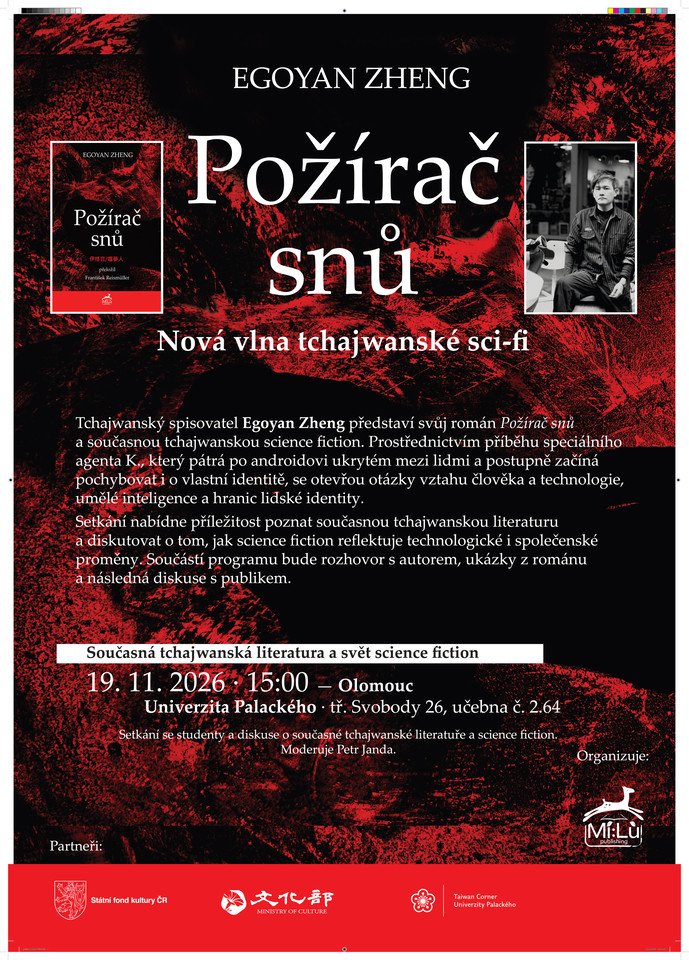
Tchajwanský spisovatel Egoyan Zheng představí svůj román Požírač snů a současnou tchajwanskou science fiction. Prostřednictvím příběhu speciálního agenta K., který pátrá po androidovi ukrytém mezi lidmi a postupně začíná pochybovat o vlastní identitě, se otevřou otázky vztahu člověka a technologie, umělé inteligence a hranic lidské identity.
Setkání nabídne příležitost poznat současnou tchajwanskou literaturu a diskutovat o tom, jak science fiction reflektuje technologické i společenské proměny. Součástí programu bude rozhovor s autorem, ukázky z románu a následná diskuze s publikem.
Moderuje Petr Janda, Ph.D.
Akce se koná v úterý 19. listopadu od 15:00 v místnosti SV 2.64.
Přednáška
Remus Li-Kuo Chen - Resilience, Values, International Partnerships: Taiwan as a Shining Example
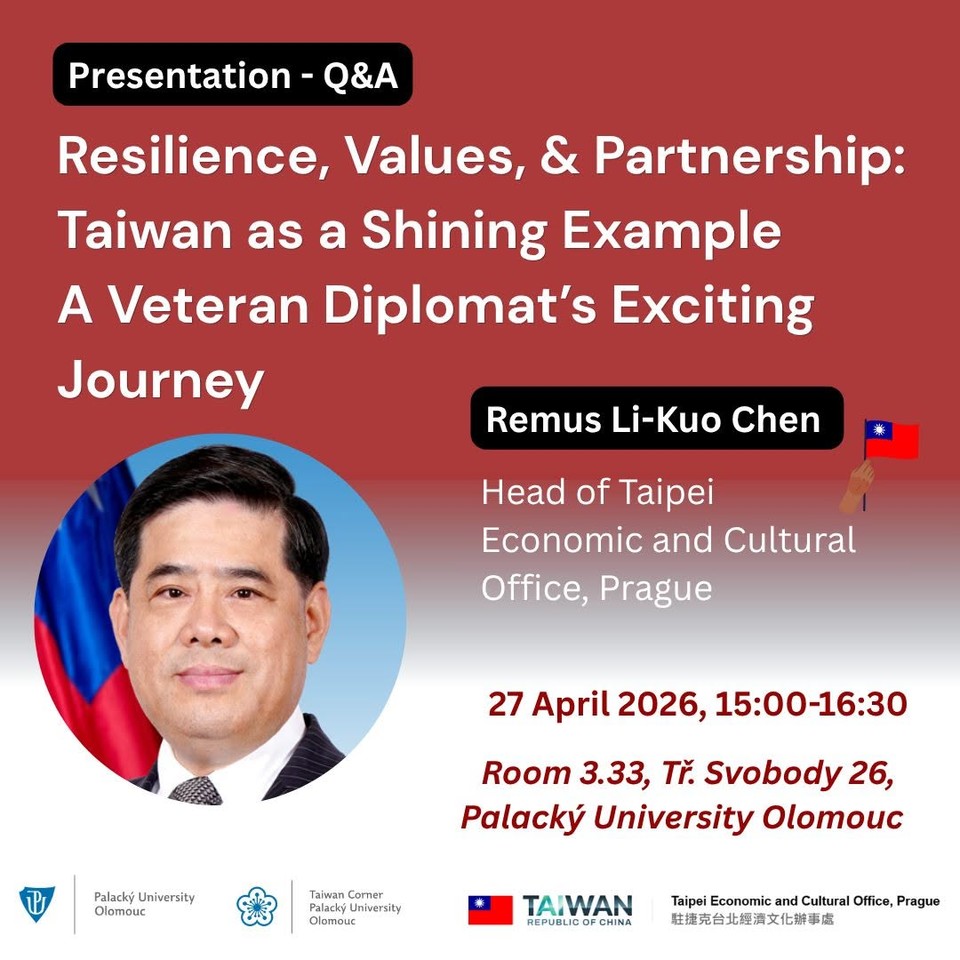
Díky spolupráci s projektem Global Taiwan Chair na Katedře asijských studií FF UP zveme na přednášku a diskusi s Remusem Li-Kuo Chenem, ředitelem Tchajpejské ekonomické a kulturní kanceláře v Praze.
Přijďte si poslechnout pohled zkušeného diplomata na roli Tchaj-wanu v dnešním světě, jeho hodnoty, odolnost a mezinárodní partnerství. Součástí setkání bude také prostor pro otázky a diskusi.
Akce se koná 27. dubna 2026 od 15:00 do 16:30 v místnosti 3.33, tř. Svobody 26, Univerzita Palackého v Olomouci.
Přednáška
Jan Karlach - China’s Southwestern Borderlands: Indigeneity, Ecology and Geopolitics
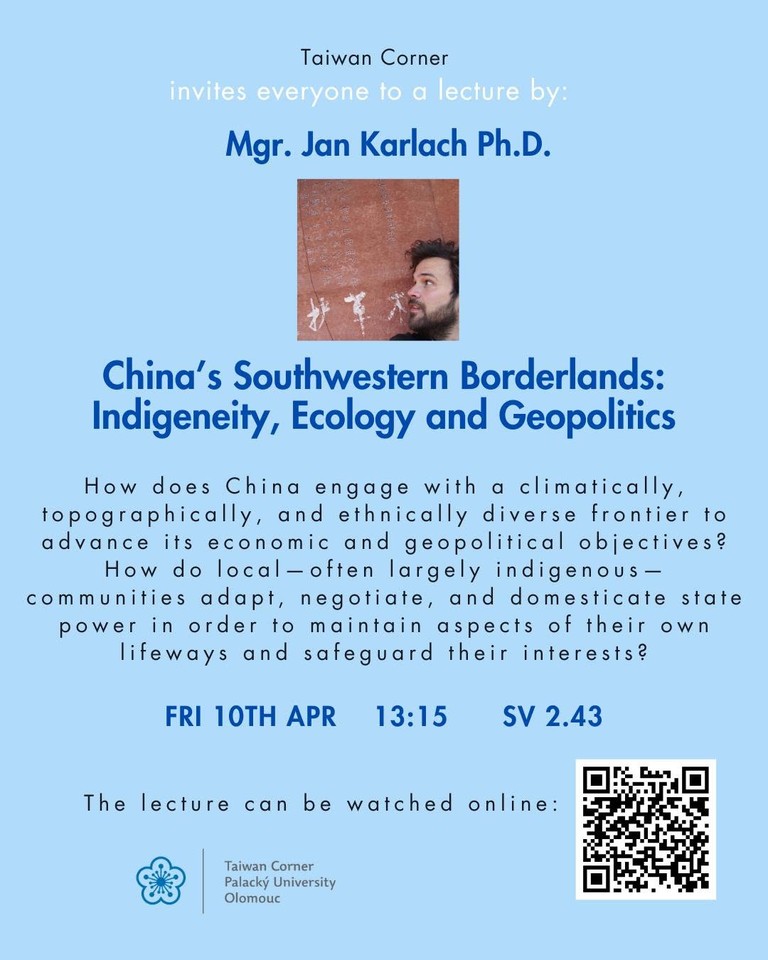
Taiwan Corner zve na přednášku Mgr. Jana Karlacha, Ph.D. s názvem China’s Southwestern Borderlands: Indigeneity, Ecology and Geopolitics.
Přednáška se zaměří na to, jak Čína přistupuje ke svým jihozápadním pohraničním oblastem, které hrají důležitou roli v jejích ekonomických a geopolitických strategiích, včetně iniciativy Belt and Road a domácí zelené transformace. Pozornost bude věnována také tomu, jak místní, často původní komunity vyjednávají se státní mocí a snaží se chránit vlastní způsob života a zájmy.
Akce se koná v pátek 10. dubna od 13:15 v místnosti SV 2.43 na Katedře asijských studií FF UP v Olomouci. Přednášku bude možné sledovat také online prostřednictvím QR kódu na plakátu.
Přednáška
Culture Salon - Taiwan: History, Travel & Lifestyle
Taiwan Corner a UAAT-ICU Mandarin Learning Center zvou na Culture Salon - Taiwan: History, Travel & Lifestyle.
Přijďte hned v prvním týdnu semestru poznat Tchaj-wan v rychlém a přístupném úvodu do jeho historie, geografie, tradičních svátků, zvyků, každodenního života, cestování i gastronomie. Setkání je vhodné pro všechny, kdo se o Tchaj-wan zajímají, a může posloužit také jako skvělé intro před plánovaným studijním výjezdem. Součástí programu bude i prostor pro otázky a diskusi s prezentující.
Akce se koná ve čtvrtek 12. února od 18:30 do 20:15 v místnosti SV 2.43 na Katedře asijských studií FF UP v Olomouci. Účast je možná po registraci prostřednictvím QR kódu na plakátu.
2025
Marie Leflerová - první česká vědecká diplomatka na Tchaj-wanu
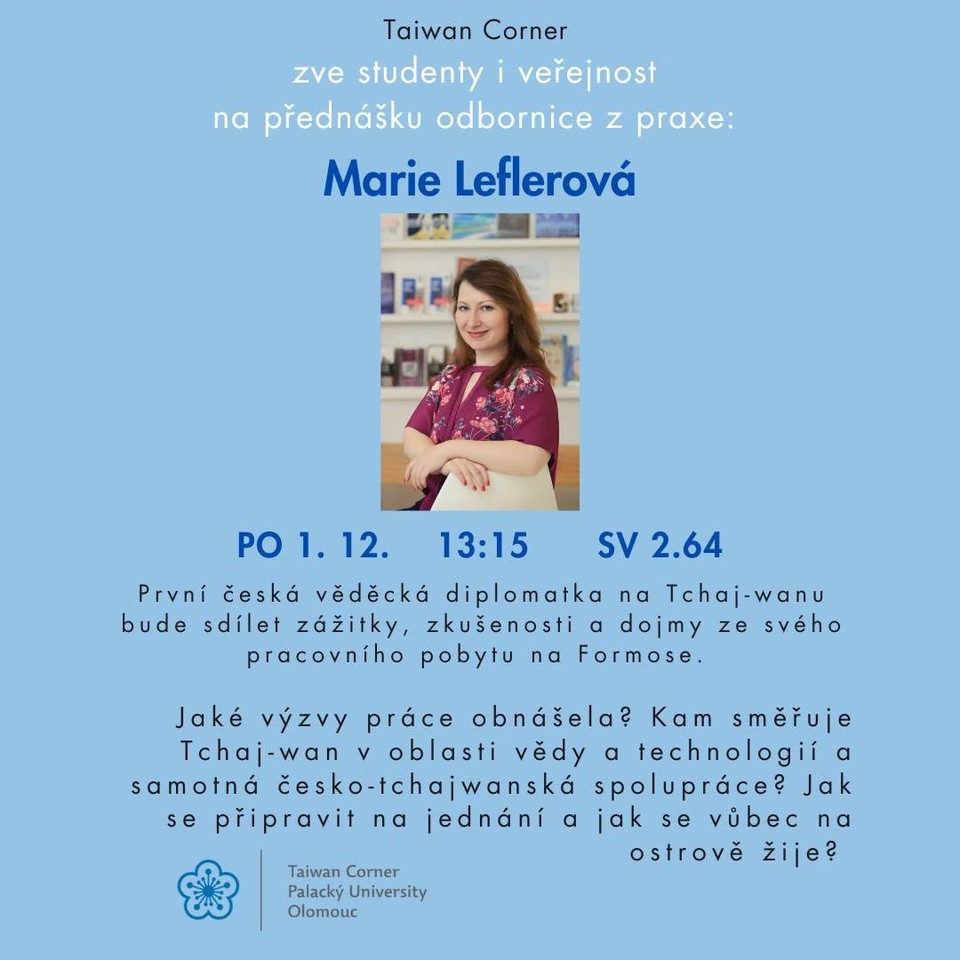
Taiwan Corner zve studenty i veřejnost na přednášku Marie Leflerové, odbornice z praxe a první české vědecké diplomatky na Tchaj-wanu.
Přijďte si poslechnout její zážitky, zkušenosti a dojmy z pracovního pobytu na Tchaj-wanu. Přednáška se zaměří na to, jaké výzvy tato práce obnášela, kam směřuje Tchaj-wan v oblasti vědy a technologií, jak se rozvíjí česko-tchajwanská spolupráce i jak se na ostrově žije.
Akce se koná v pondělí 1. prosince od 13:15 v místnosti SV 2.64.
Dr. Jacob F. Tischer - Technologies of Animation in Taiwanese Popular Religion
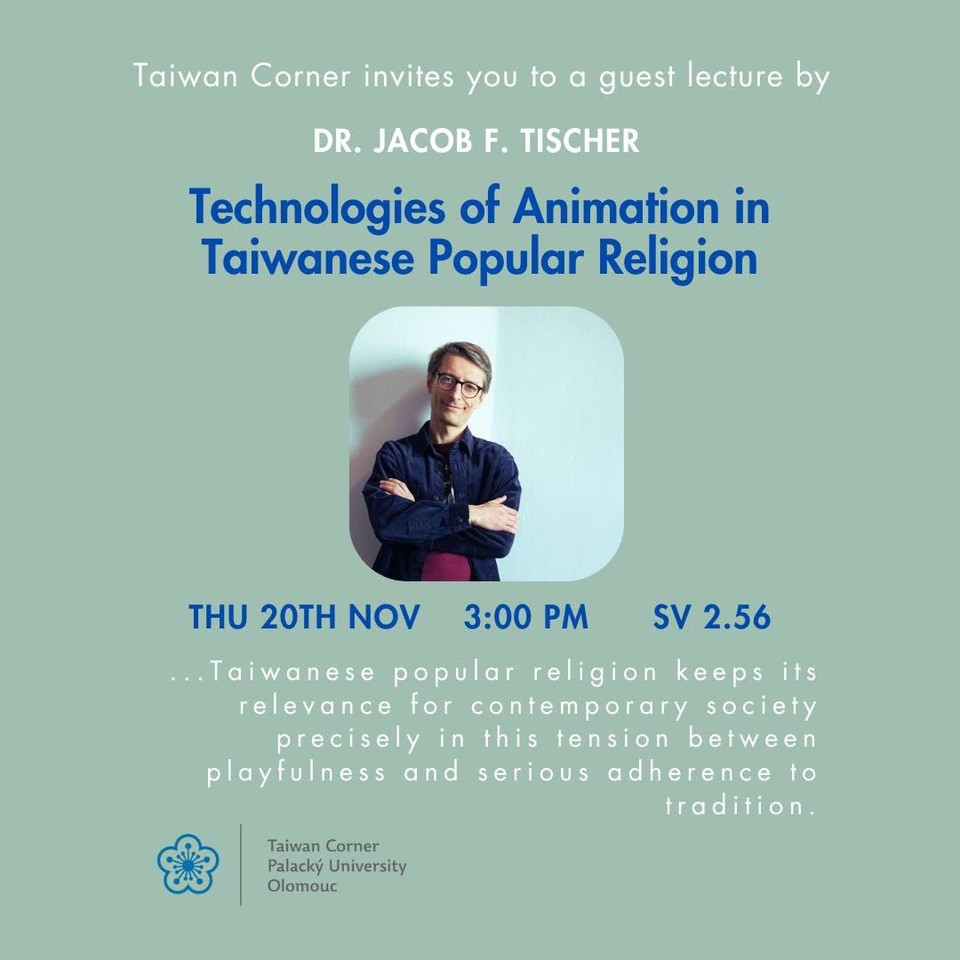
Taiwan Corner zve na přednášku Dr. Jacoba F. Tischera z Univerzity Karlovy s názvem Technologies of Animation in Taiwanese Popular Religion.
Přednáška představí praktiky tchajwanského lidového náboženství, které „oživují“ božstva a další posvátné objekty, od rituálů otevírání očí božských soch až po každodenní péči o ně. Zaměří se na napětí mezi hravostí, performancí a vážným dodržováním tradice, díky němuž si tchajwanské lidové náboženství udržuje význam i v současné společnosti.
Akce se koná ve čtvrtek 20. listopadu od 15:00 v místnosti SV 2.56 na Katedře asijských studií FF UP v Olomouci.
2023
Sdílení zkušeností aneb jak se nám studovalo na Taiwanu
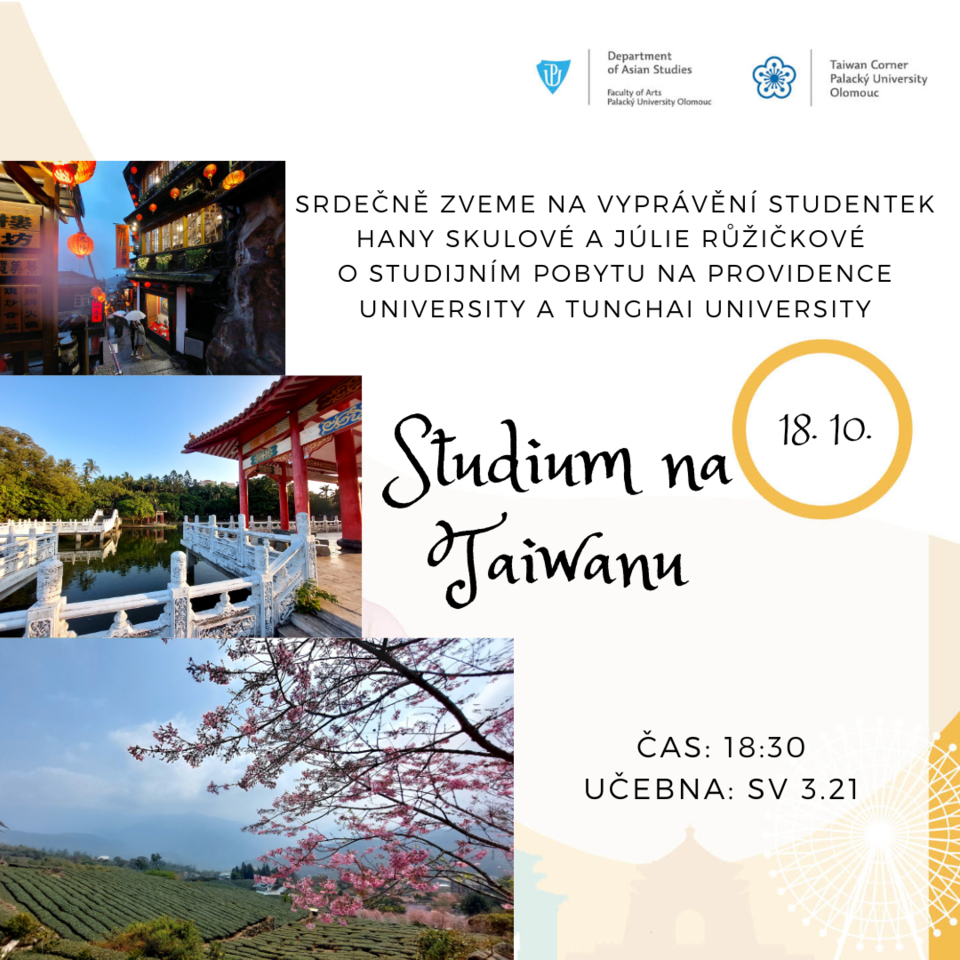
Život a studium na Taiwanu očima našich studentek již ve středu 18. 10. 2023 v Taiwanskému koutku.
čas: 18:30 - 20:00
Těšíme se!
Long Forgotten History: Bohumil Pospíšil's Adventure in Formosa in 1929
Public lecture by I-Hsun (Sandy) Chou, LL.M., JSD. (Fullbright scholar at Faculty of Law, Palacký University Olomouc) about the Czechoslovak explorer and traveller Bohumil Pospíšil and his trip to Taiwan.
DATE AND PLACE
March 15, 2023, 13:15–14:15
Room SV 2.56
ABSTRACT
96 years ago, Czechoslovak explorer and traveller Bohumil Pospíšil (1902-1974) started his first journey to Asia (1926-1931). His adventure took him to Formosa/Taiwan, an island little known to the people in the interwar Czechoslovakia. Pospíšil came to Formosa at an exciting time for both Czechoslovakia and Taiwan. Czechoslovakia had just gained its independence and quickly developed into a modern, vibrant industrial power in Europe. Taiwan, as a Japanese colony, benefited from liberal and democratic trends in Japan, and enjoyed a period of time often referred to as Taishō Democracy. Pospíšil and his secretary, Josef Hübl, were welcomed warmly by the prominent Taiwanese political activist, Chiang Wei-shui. Chiang invited them to give a public speech regarding their journey and the independence of Czechoslovak, which was a highly sensitive topic. This crowded event ended up being forcibly interrupted by the Japanese police. The rest of their trip was shadowed by Japanese secret police following them everywhere.
In his photo collection, Pospíšil paid special attention to the aboriginal Taiwanese. Among others, he collected pictures of brutal executions of native Taiwanese by the Japanese police. While most people, Japanese or foreign visitors alike, had the impression that the colonial government has successfully governed the aboriginals, Pospíšil might have foreseen that the most tragic conflict between the Japanese colonial government and the ingenious Taiwanese would take place soon after his visit.